Today we will be talking about Marvel's most diverse group of heroes. The X-MEN are not only the most diverse racially but they show a vast variety of gifts and complications that reflect our real world. In the article "X-Men" as J Men: The Jewish Subtext of a Comic Book Movie the author depicts an interesting argument a answer, a why to the question of the characters and motives for their actions. The author claims that most of the characters motives rest upon the questionable assumption that it has a lot to do with the background of the creators. In other words he believes that Stan Lee and Kirby were both descendants of Jewish immigrants that were trying to fit into society. Lawrence Baron himself writes "X-Men comic book series belong to the generation of American-born Jews who sought acceptance and social mobility through assimilation." This is then reflected especially by Magneto. At the start of the X-Men film we find out he is a survivor of the holocaust. He saw the atrocities when his whole family was executed, when he escaped he realized he could not let the same event happen, he had to protect people like himself. In Baron's view Magneto is paranoid. He then goes on to say that this paranoia is a reflection of the authors, that they had to tell the truth and they did in the best way they could-through comics. Baron complicates matters further when he writes "American Jewish sympathy for the mainstream of the Civil Rights Movement also left its mark on the characters and plots of X-Men and other Marvel comic books." Basically he is implying that the wonderful action packed stories of the X-Men fall back on a deeper picture that reflects in the author's words "...ethnic minorities who dreamed up the original comic book superheroes projected their own social insecurities onto their creations by depicting them as aliens or physically distinctive beings who gladly relinquished "their heritage, in part or in full, for assimilation into the American melting pot." To finish of his article the author reminds us of the success the series has had, and it is amazing to see how far it has come but my only question is "Can we really base all that success off mere sympathy and original author's mask?" I agree with him partially but there has to be something more "I don't know" less emotional.
Well, let me start of by saying that "it's not that I do not believe in emotion." Appealing or having emotional motives can always attract a large audience because a majority of society has feelings. Yes, I understand that it's effective and we can credit it's success to it but hear me out for a bit. Baron overlooks what I consider an important point about human differences. Although I do believe that the authors had some emotional effect to the horrors committed half across the world, I do not believe those fueled all their motives. My own view is that Kirby and Lee saw the possibility of a great story. They did not experience first hand the concentration camps and troubles but they were conscious that they existed. What if they saw this as an opportunity to attract a large audience that wanted to read a relate-able story. I just find it hard to believe that these awesome stories came just from a mask that the authors wanted to show. That their motives were to write about their personal problems and what they had to go through in the melting pot of the U.S. Anyone familiar with the X-Men movies and comics should agree that what attracts us the most is the diversity and action. Yes, there might be an underlying deeper connection with the stories but we love to see the explosions and the different gifts the mutants show. Yes, the overall plot is a Magneto trying to save his own kind almost an anti-hero that has reasonable justification for his motives. But if the authors did recognize the horrors committed, I do not think they would write a story that does the same but not to Jewish this time, in this story humans are the ones that have to be killed and eradicated. My feelings on the issue are mixed. I do support Baron's argument that there is an emotional background to the story, but I find his argument difficult to digest because they could have just seen the idea and opportunity to write about an emotional topic and run with it not necessarily to reflect their feelings. Yes maybe spread awareness and possibly to reflect their feelings but ultimately I believe they are just creative writers playing the role to develop these amazing stories.
Friday, October 9, 2015
Thursday, October 8, 2015
Charley's War
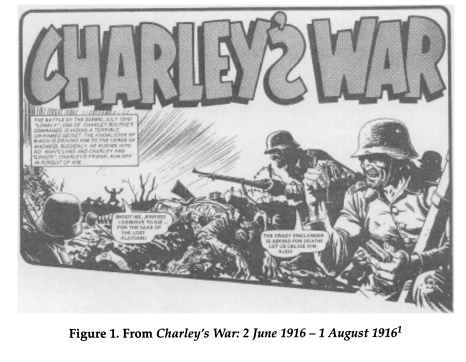
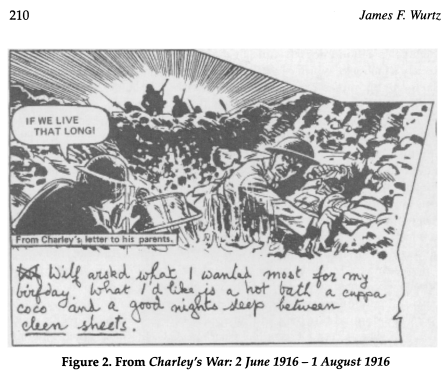
Welcome, all, to this discussion of the morality, influence, and aesthetic of the World Wars and the effect they had on the industry of graphic novels! We have linked many details, comic books, and individual panels to the Second World War, in particular. Now, I would like to bring to your attention to a philological analyzation of the literature of the World Wars and how the multiple texts which the events have birthed have influenced many peculiarities singular to the graphic novel. Written by James F. Wurtz, "Representing the Great War: Violence, Memory, and Comic Form" outlines the key ways in which literature, current events, and personal experience have shaped the stylistic approaches and hidden meaning rooted in comic books such as, Charley's War. This comic strip, published in the British Battle Picture Weekly comic book series, takes a distinctive view on the World Wars and delivers a subtle, yet powerful anti- war message. Wurtz states, "Carefully researched, his [Charley's] story maintained a firm grounding in the reality of daily life in the trenches while presenting its anti-war message in terms that readers could both understand and enjoy reading." (207). When discussing comic literature, Wurtz introduces the idea that many assume the position that this literary and artistic form is childish and meant for a young audience. Although this is true for some comics, Wurtz explains that Charley's War uses a combination of unusual, 'non- linear' images, or 'signposts', which do not appear in a set order to create a deeper meaning, allowing older readers to enjoy the book as well. "Charley's War, however, makes careful use of its visual and verbal "signposts," creating a disjunction between narrative and representation that rejects linearity and thus allows the "hidden political significance" to emerge." (Wurtz, p.206). He goes on to explain that coupled with well- written captions, the comic portrays a virtuosic work meant for readers of all ages. "The dialogue and the captions are clearly aimed at a younger audience, but the complexities of the art and the relationship between the pictures and the words undermine the idea that this is children's literature."(Wurtz, p.207). This consideration is notable, because it secures the literary magnitude and depth of the comic book. On a side note, it seems that Pat Mills and Joe Colquhoun, the authors of the novel, have found the perfect middle ground and literary medium to project their ideas of World War I & II to an audience of all age groups. Going deeper into the subject, Wurtz begins to analyze the characters which are used in comic books, and what races are associated with either friend or foe. He himself writes, "With a clear-cut enemy to fight against, heroes like Superman, Captain America, Daredevil, and the Human Torch sold comics as they battled stereotypical Nazis and caricatures of Japanese soldiers." (206). In making this observation, Wurtz urges us to make the connection between historical events and the races used in comics to illustrate enemies and comrades, alike. The author continues describing attributes of the Charley's War which point to the traditions, personal accounts, and internal conflicts surrounding the World Wars. He introduces the argument that this interpretation of war, in general, in combination with aesthetically pleasing art can be used to advance the business model of the publication, and in effect, the work can lose its profound meaning. "When memory becomes commodity, it becomes available for consumption to any one. Likewise violence, rendered artistically and sold, loses its referent and so loses its impact." (Wurtz, p.213). His point is that by interpreting comics from an aesthetical viewpoint, war, itself, becomes beautiful, as any work of art. However, Wurtz maintains that Charley's War is an exception to his previous claim. "Charley's War portrays the violence of the war with the specificity of detail and the emotional impact of the abstract in order not to de-commodify but to represent the destruction of the Great War in such a way as to make impossible any interpretation of violence as beautiful." (Wurtz, p.214). This concludes Wurtz's article, and provides us with the full theory of the artist on the subject of the Wars influencing comic book style, content, and marketing.
Taking into account the arguments, observations, and opinions of James F. Wurtz, a firm connection can be established between his work and the assertion of World Wars influencing the races of post-war comic book heroes and villains. Wurtz proves through his analyzation of Charley's War that the political, social, and subliminal meaning behind comic books can be very complex, and simply dismissing them as a child's form of entertainment cannot be justified. This exact meaning varies throughout the differing stories of superheroes, but in this case, the message against war is crystal clear. It can be inferred that the writer and illustrator of this comic did not realize the shortcomings of their comic in the area of equality, since their moral is one of peace and prosperity. That being said, the authors still did not use much racial variation when it came to races not directly involved with the Second World War. Perhaps this is due to the personal experience the men had with the war. On the other hand, business aspirations and the views of common people who bought the books must have also played a role in the decision, or non-decision, of including other races such as African Americans in the comics. Whatever the influencing factor may be, comic books of different origin throughout the United States demonstrate the same patterns of predominance of white characters, and I stand beside my original idea of the World Wars inhibiting equality in comic books, whether it be due to personal experience, sociological standpoints, or business endeavors.
Comic Books and Wars
Today
I will be reviewing the article, “Written in Red, White, and Blue: A Comparison of Comic
Book Propaganda from World War II and September 11,” by Cord Scott.
In the article Scott compares comic book propaganda with the attacks of Pearl
Harbor and the September 11. Scott brings out that writers of comic books would
use their comics as a form of propaganda to get their readers to join the army
and support their country. He goes on to name a few comic book characters that
appear with a patriotic duty such as Uncle Sam, Blackhawk, Fin, Boy Commandos,
and Citizen V. He mentions that by the end of the
World War II comic books had accomplished its
goal of getting people to join and support the war.
In
the article Scott states,"As the threat of war in Europe turned
into reality in 1939, comics in the United States incorporated the
real villains into their story lines. The villains in the
books had exotic names and came from yet familiar locales, but adults
recognized the true origins," which shows how comic books were used
as a form of propaganda for the war back in the 1940's. He goes on to say
how different ethnicities were stereotyped and as the
wars continued the more the stereotypes increased. Many would argue
that by doing this that comic books were being racist but I would have to
disagree. The writers of comics were just portraying the "enemies" of
the United States during the war in the worst possible way to try to
influence their readers and to get them to join the army. "Youth, especially younger people who
are formulating ideas (and are the basis for marketing of comic books), needed
to be given these characterizations and the subtle stereotypes, so that when
the time came children would help in the war effort," Scott says in his
article and I would have to agree with him because comic books were
very successful in getting many youths to join the army because of the way they
did portray the "villains".
Overall I
really enjoyed reading this article by Scott because he had brought out many
good points about propaganda in wars. Although the enemies of the U.S. were
portrayed very stereotypical there was a very good reason to this which
Scott helped his readers understand.
Wednesday, October 7, 2015
Academic Article
Hey
guys! I’m back with another post. I am going to be talking about the article/book
I read this week about how propaganda and comics leads to racial justification
of whites in American comics.
Bradford W. Wright, the author of “Comic Book Nation: The Transformation of Youth Culture in America”, talks about the portrayal of American superheroes as amazing beings that help the fight war and prevent crises in comic books. As stated by the article/book, they are American beings who help a lot in the world; they help the Chinese, South Americans, Mexicans, and Native Americans. It is essentially propaganda depicting American superheroes (and implying Americans) as the ones people should follow and guide to be. It is intriguing to note that the Superheroes mentioned in this article/book are white. He communicates the main idea of propaganda through examples seen in comics. For example; there is a comic Bradford Wright mentions about a group of American female army trainers going to China, only to discover a Japanese spy within the Chinese ranks. It is propaganda of how the American people helps those in need (in this case, the Chinese). In another example, in one of the comics Wright mentions, the Boy Commandos fight alongside Russian troops against the Germans. Again, it is propaganda because of the hospitality the U.S. is giving out to the countries that need help.
The author’s argument about Superheroes as propaganda is interesting. I like how he is using propaganda to explain why comic books and their characters prevailed to the American audience. I find that the comic characters he mentions (predominantly white and American) committing rightful acts in the world really hits the nail of American propaganda. I also like how he mentioned the comic book characters support the idea that the U.S. is a “melting pot” and that all people in America, no matter what ethnicity, are Americans. The only thing that I questioned is that even though these characters were portrayed as the ones who defend the idea of America as a melting pot of every race and Americans hospitality to the world, why aren’t there different races of superheroes fighting and doing rightful acts throughout the world? I thought of this question while reading the article/book. While I agree that while there was a lack of character diversity in comic books at the time, a point that needs emphasizing is that many people still believe that because of the lack of diversity, comics of the past and even the present are racist. They have to understand that during that time, a war was raging on. Propaganda was one of the ways to portray the American people as the ones who can help out an end and be considered as the ones to help shape the world. In order to be more American, the use of predominant White comic characters really helped engrave the American ideal that the U.S. can help with what is happening. It was practically propaganda during a national crisis. .Though I concede that it would have been better to have a more diverse amount of super hero characters during that time period, I still insist that having predominant white characters in the fray was justifiable, given the circumstances. The comics the author used in this article/book were used as propaganda for the United States. It was showcasing the U.S. as a “…big brother, one who is quick to intervene...” (Wright 52).
Bradford W. Wright, the author of “Comic Book Nation: The Transformation of Youth Culture in America”, talks about the portrayal of American superheroes as amazing beings that help the fight war and prevent crises in comic books. As stated by the article/book, they are American beings who help a lot in the world; they help the Chinese, South Americans, Mexicans, and Native Americans. It is essentially propaganda depicting American superheroes (and implying Americans) as the ones people should follow and guide to be. It is intriguing to note that the Superheroes mentioned in this article/book are white. He communicates the main idea of propaganda through examples seen in comics. For example; there is a comic Bradford Wright mentions about a group of American female army trainers going to China, only to discover a Japanese spy within the Chinese ranks. It is propaganda of how the American people helps those in need (in this case, the Chinese). In another example, in one of the comics Wright mentions, the Boy Commandos fight alongside Russian troops against the Germans. Again, it is propaganda because of the hospitality the U.S. is giving out to the countries that need help.
The author’s argument about Superheroes as propaganda is interesting. I like how he is using propaganda to explain why comic books and their characters prevailed to the American audience. I find that the comic characters he mentions (predominantly white and American) committing rightful acts in the world really hits the nail of American propaganda. I also like how he mentioned the comic book characters support the idea that the U.S. is a “melting pot” and that all people in America, no matter what ethnicity, are Americans. The only thing that I questioned is that even though these characters were portrayed as the ones who defend the idea of America as a melting pot of every race and Americans hospitality to the world, why aren’t there different races of superheroes fighting and doing rightful acts throughout the world? I thought of this question while reading the article/book. While I agree that while there was a lack of character diversity in comic books at the time, a point that needs emphasizing is that many people still believe that because of the lack of diversity, comics of the past and even the present are racist. They have to understand that during that time, a war was raging on. Propaganda was one of the ways to portray the American people as the ones who can help out an end and be considered as the ones to help shape the world. In order to be more American, the use of predominant White comic characters really helped engrave the American ideal that the U.S. can help with what is happening. It was practically propaganda during a national crisis. .Though I concede that it would have been better to have a more diverse amount of super hero characters during that time period, I still insist that having predominant white characters in the fray was justifiable, given the circumstances. The comics the author used in this article/book were used as propaganda for the United States. It was showcasing the U.S. as a “…big brother, one who is quick to intervene...” (Wright 52).
Thursday, October 1, 2015
Analyzation of Jack Kirby's "Black Cat Mystic" Cover Illustration
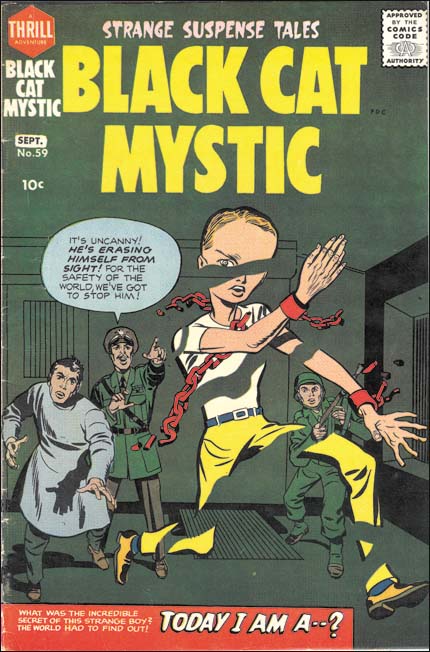
Again, welcome to those who visit this domain of war and heroes and wish to unravel the meaning behind the most famous of graphic novels. Recently, upon touring the Jack Kirby artwork exhibit at the California State University of Northridge, I came across an illustration which seemed to envelope my hypothesis of the World Wars affecting racial qualities of both heroes and villains. The artwork was the cover of a graphic novel titled, "Black Cat Mystic." It was, as expected, illustrated by Jack Kirby, who, himself, had served in the Second World War as a scout who advanced into towns and drew reconnaissance maps of enemy positions, an inherently perilous job. Kirby used his knowledge of the conventions of graphic illustration, symbolic meaning, and World War 2 enemies to provide an image that lures readers in with purely sensory perceptions, but the seemingly proactive composition of these elements may have been what brought the comic such an infamous reputation.
Jack Kirby's illustration of this particular cover involves many different aspects of artistic communication of feeling and emotion. Initially, the first major characteristic the viewer notices is the bright colors of the hero, contrasting with the dull, lifeless, and murky green of the background setting and characters. The hero's bright red chains stand out to highlight the fact that the hero was being held against his will, and is now possibly escaping. Feelings of freedom, or the struggle to obtain it, flood the mind's eye. Using the variety of color, the range of emotion felt when experiencing the image expands, "With these three colors, plus white, I [have] a wide emotional range, and each color [is] distinct from the others” (Bang, 13). The use of space throughout the cover is significant because of the placement of each figure and their orientation on the page. The hero is centered, ensuring that this is the first body we examine. The enemies are positioned smaller and higher on the page, and with the help of the lines used to detail the walls and ceiling, create the illusion of depth. “By arranging the pieces so that the thinner they are, the higher upon their page their bases are placed, a perception of depth occurs" (Bang, 16). The hero is seen as leaping out of danger as the enemies desperately attempt to catch him, showing another layer of artistic depth.
Tying this image into my discussion of Wars, Jack Kirby used specific elements which stood as symbols and direct allusions to World War 2. The enemies, for example, are seen wearing typical Nazi regalia. When compared to the uniform of a Nazi general, the man speaking in the picture has a nearly identical uniform, The figure on the far left resembles a doctor or scientist due to the lab coat, and this fits the allusions to Nazi Germany, as they were known to conduct vile experiments behind the public eye. Even the gun, although it is not seen very well, can be tied to the Gewehr model, a Nazi favorite when it came to rifles used in the war. But how are these meticulous details related to the predominance of the white race in comic books?
Jack Kirby was obviously knowledgeable of the slight details he drew on this cover. However, did he use these specific peculiarities because the World Wars influenced him, possibly through experience in his own life? Or were the details used to further the popularity of the comic by baiting angry, or perhaps, action-seeking viewers of post- World War America? Whatever the true motive may be, only caucasian faces appear on the cover, and there may be a significant consequence behind this fact. Comic book fanatics argue that this particular issue did not receive much popularity and positive feedback because of the delayed release. Others persist that the idea of the Living Eraser didn't seem very bright, adding to the misfortune of the comic's public reception. I, however, maintain that the use of so many post-war allusions was getting dry or morose for the public, and the demand for variety, including that of a racial nature, in graphic novels was on the rise. In addition, the 1950s were a ripe time for the comic book industry, as the first heroes of African American descent began to appear in the works of famous companies such as Entertaining Comics.
Conclusively, this comic possesses many positive features such as the uses of line, shape, color, and space. Additionally, the details which tie the comic to World War 2 are very detailed and do not stray far from the facts of the war. However, upon further examination, the failure of this issue, in particular, may have been due in part to the fact that there is no variety in race on the cover. This seems unlikely at first, but considering that some of the first African- American and Asian- American heroes were to appear in comics a mere 5 years later strikes an important theme.The people of the United States, a country built upon immigration and opportunity, became more open to the idea of racial variation in popular comics following the Second World War. Perhaps people realized that the country they lived in was so special and unique because of the social variety, striking deep into the environment of racial tension among citizens and heroes, alike. But that is a discussion for another day. Farewell.
Jack Kirby's illustration of this particular cover involves many different aspects of artistic communication of feeling and emotion. Initially, the first major characteristic the viewer notices is the bright colors of the hero, contrasting with the dull, lifeless, and murky green of the background setting and characters. The hero's bright red chains stand out to highlight the fact that the hero was being held against his will, and is now possibly escaping. Feelings of freedom, or the struggle to obtain it, flood the mind's eye. Using the variety of color, the range of emotion felt when experiencing the image expands, "With these three colors, plus white, I [have] a wide emotional range, and each color [is] distinct from the others” (Bang, 13). The use of space throughout the cover is significant because of the placement of each figure and their orientation on the page. The hero is centered, ensuring that this is the first body we examine. The enemies are positioned smaller and higher on the page, and with the help of the lines used to detail the walls and ceiling, create the illusion of depth. “By arranging the pieces so that the thinner they are, the higher upon their page their bases are placed, a perception of depth occurs" (Bang, 16). The hero is seen as leaping out of danger as the enemies desperately attempt to catch him, showing another layer of artistic depth.
Tying this image into my discussion of Wars, Jack Kirby used specific elements which stood as symbols and direct allusions to World War 2. The enemies, for example, are seen wearing typical Nazi regalia. When compared to the uniform of a Nazi general, the man speaking in the picture has a nearly identical uniform, The figure on the far left resembles a doctor or scientist due to the lab coat, and this fits the allusions to Nazi Germany, as they were known to conduct vile experiments behind the public eye. Even the gun, although it is not seen very well, can be tied to the Gewehr model, a Nazi favorite when it came to rifles used in the war. But how are these meticulous details related to the predominance of the white race in comic books?
Jack Kirby was obviously knowledgeable of the slight details he drew on this cover. However, did he use these specific peculiarities because the World Wars influenced him, possibly through experience in his own life? Or were the details used to further the popularity of the comic by baiting angry, or perhaps, action-seeking viewers of post- World War America? Whatever the true motive may be, only caucasian faces appear on the cover, and there may be a significant consequence behind this fact. Comic book fanatics argue that this particular issue did not receive much popularity and positive feedback because of the delayed release. Others persist that the idea of the Living Eraser didn't seem very bright, adding to the misfortune of the comic's public reception. I, however, maintain that the use of so many post-war allusions was getting dry or morose for the public, and the demand for variety, including that of a racial nature, in graphic novels was on the rise. In addition, the 1950s were a ripe time for the comic book industry, as the first heroes of African American descent began to appear in the works of famous companies such as Entertaining Comics.
Conclusively, this comic possesses many positive features such as the uses of line, shape, color, and space. Additionally, the details which tie the comic to World War 2 are very detailed and do not stray far from the facts of the war. However, upon further examination, the failure of this issue, in particular, may have been due in part to the fact that there is no variety in race on the cover. This seems unlikely at first, but considering that some of the first African- American and Asian- American heroes were to appear in comics a mere 5 years later strikes an important theme.The people of the United States, a country built upon immigration and opportunity, became more open to the idea of racial variation in popular comics following the Second World War. Perhaps people realized that the country they lived in was so special and unique because of the social variety, striking deep into the environment of racial tension among citizens and heroes, alike. But that is a discussion for another day. Farewell.
Cold War
I was at the Jack Kirby Museum this week and I came across a photo that will ignite our talk this weekend. We have talked about race and the issues that come with it. Time periods show us different sides of comics and today we will be talking about the time after World War II. We now enter the Cold War and how this event changed America and different race cards were played. Jack Kirby illustrated a cover, in which American's are planting a flag on the moon. The Cold War terrorized America, the fear of getting bombed any day drove people crazy. The threats created many fall out shelters that were never used. The spying that scared everyone later turned into great video game plots. The space race changed the World. It was clear that the two leading countries in the space race were the USSR and the USA. Comics were used as propaganda at this time. This cover let me to think that a lot of the things portrayed or said in comics are racist but no one points them out. They always show America coming in first place and this also brings us together.
The slang terms used in these comics referring to Russians as commies, showing the horrible and exaggerating the acts of the USSR are in a sense you know racist. However no one wants to think about it like that because the Cold War was a real issue. It was a real problem and in reality the USSR was the enemy. It was nothing to be played around with, the threats and the problems were real. People were hurt and devastated by it, they spend fortunes on fall out shelters and changed the way of thinking. In fact the problem died out and we eventually won the argument and with it amazing stories and movies were left behind for us to watch today. We glorify and give these acts a high place in movies and games that no one stops to think that the things said and done were racist. The fact that we kill commies in games and that commies suck, and should die etc. is honestly bad. Yet, no one really points it out, like they were just soldiers paying attention and following orders, yet we degrade them. This just shows that as a society sometimes we just want to be bias about what goes on in the media and want to see how we can an advantage on a certain situation. The Cold War Ended and somehow even though racist trends were left behind it was a good thing for business. Or is it the fact that all the racist scenes have a justification or is it because it does not attack to us. I mean if we are going to talk about racism lets talk about it through all four corners. In my opinion these comics have a justification but what I want to get across is that some people want to overlook what is racist and just focus on what affects them. I don't think it should be like that especially if you want to argue that comics are racist. In my opinion they aren't and should we really trust everyone who says that does, just remember that there is actual racism most brush off and we should take a closer look on the issues we are about to fight for before we just follow the flow and raise up signs and protest. Let's get a bit educated.
Subscribe to:
Posts (Atom)